
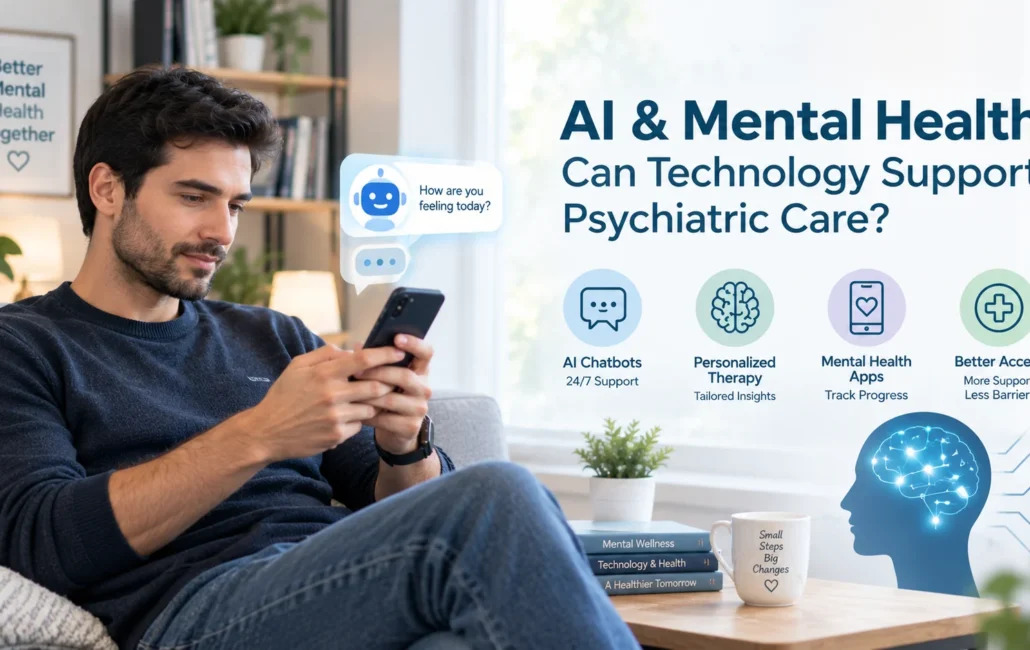

AI & Mental Health: Can Technology Support Psychiatric Care?
Technology is becoming an increasingly important part of modern healthcare, and mental health care is no exception. From telehealth appointments and mental health apps to artificial intelligence (AI)-powered tools, new technologies are creating additional ways for patients and mental health professionals to connect, communicate, and manage care.
But as AI becomes more common, an important question arises: Can technology actually support psychiatric care, or could it replace the human connection that is essential to mental health treatment?
The answer is that technology can be a valuable supportive tool, but it should complement—not replace—the expertise, judgment, and compassion of a qualified psychiatric professional.
At New Bridge Psychiatry, we believe effective mental health care begins with understanding the individual. Technology may help make certain aspects of care more accessible and efficient, but personalized psychiatric evaluation and treatment remain at the heart of quality mental health care.
What Is Artificial Intelligence in Mental Health Care?
Artificial intelligence refers to computer systems that can analyze information, recognize patterns, generate responses, and perform tasks that traditionally require human intelligence.
In mental health care, AI is being explored and used in several areas, including:
- Mental health screening and assessment
- Patient education
- Symptom tracking
- Digital mental health applications
- Appointment and communication support
- Treatment monitoring
- Clinical documentation
- Research and data analysis
- Personalized health recommendations
Some AI tools can analyze information provided by patients and identify patterns that may be useful to healthcare professionals. Others are designed to provide general educational information or help patients track symptoms between appointments.
However, AI does not have the same ability as a psychiatrist to understand the full context of a person’s life, medical history, relationships, emotions, or changing circumstances.
How Can Technology Support Psychiatric Care?
Technology can support mental health care in several meaningful ways. When used appropriately and under professional guidance, it may improve accessibility, communication, and continuity of care.
1. Improving Access to Mental Health Services
One of the biggest advantages of technology is improved access.
Telepsychiatry allows patients to meet with psychiatric professionals remotely when appropriate. This can be particularly helpful for individuals who have difficulty traveling to an office, live far away, have busy schedules, or prefer the convenience of receiving care from home.
Virtual appointments can make it easier for some patients to stay connected with their healthcare provider and maintain continuity of treatment.
Technology does not necessarily make psychiatric care less personal. In many cases, it provides another way for patients and providers to maintain a meaningful therapeutic relationship.
2. Helping Patients Monitor Symptoms
Mental health symptoms can change over time.
Mood, anxiety, sleep, energy levels, concentration, and other symptoms may fluctuate from day to day. Digital tools can help patients record these changes and identify patterns.
For example, a patient might use an app or digital journal to track:
- Mood changes
- Sleep patterns
- Anxiety levels
- Medication reminders
- Energy levels
- Stress levels
- Daily routines
This information may help patients become more aware of their experiences and can sometimes provide useful information to discuss with their psychiatrist.
However, symptom tracking should be viewed as a tool—not a diagnosis.
A change in mood or sleep does not necessarily indicate a particular psychiatric condition. A qualified professional must consider the broader clinical picture.
3. Supporting Patient Education
Understanding a mental health condition can help patients become more involved in their treatment.
Technology gives people access to a large amount of educational information about conditions such as:
- Anxiety
- Depression
- ADHD
- Bipolar disorder
- Sleep disorders
- Obsessive-compulsive disorder
- Trauma-related conditions
- Other psychiatric conditions
Reliable digital resources can help patients learn about symptoms, treatment approaches, coping strategies, and questions they may want to discuss with their healthcare provider.
At the same time, patients should be careful when searching for mental health information online. Not everything published on the internet is medically accurate.
A website, social media post, or AI chatbot should not be treated as a substitute for professional psychiatric evaluation.
Can AI Diagnose Mental Health Conditions?
This is one of the most important questions surrounding AI in psychiatry.
Although AI systems can analyze information and recognize patterns, a chatbot or AI tool should not be relied upon to independently diagnose a psychiatric condition.
Psychiatric diagnosis is complex.
A psychiatrist considers many factors, including a patient’s symptoms, duration and severity of symptoms, medical history, medications, family history, lifestyle, stressors, functioning, and other relevant circumstances.
Two people may describe similar symptoms but have very different underlying causes.
For example, difficulty concentrating can occur with ADHD, anxiety, depression, sleep problems, medication effects, substance use, or other medical or psychological factors.
AI may identify a possible pattern, but identifying the correct diagnosis requires clinical reasoning and professional assessment.
Can AI Replace a Psychiatrist?
For most aspects of psychiatric care, AI should be viewed as a support tool rather than a replacement for a psychiatrist.
Mental health treatment involves much more than analyzing symptoms.
Psychiatrists listen to patients, ask follow-up questions, evaluate changes over time, consider medical and psychological factors, discuss treatment options, monitor response to treatment, and make clinical decisions based on the individual patient.
Perhaps most importantly, psychiatric care involves a human relationship.
A patient may be experiencing grief, fear, trauma, relationship difficulties, uncertainty, or a major life transition. Understanding these experiences requires empathy, context, communication, and professional judgment.
Technology can assist with certain tasks, but it cannot fully reproduce the human connection involved in individualized psychiatric care.
The Importance of Human Connection in Mental Health Treatment
Mental health treatment is deeply personal.
Many patients seek psychiatric care during some of the most difficult periods of their lives. They may feel overwhelmed, misunderstood, embarrassed, or uncertain about what they are experiencing.
A compassionate psychiatric professional can provide a safe environment where patients feel heard and respected.
This relationship can be an important part of treatment.
Technology can help make care more convenient, but convenience should never come at the expense of compassion.
The goal should not be to choose between technology and human care. Instead, the future of psychiatry may involve finding responsible ways to use technology alongside professional expertise.
Potential Benefits of AI in Psychiatry
When properly developed and appropriately used, AI may offer several potential benefits to mental health care.
Greater Efficiency
AI may help healthcare professionals with administrative and documentation-related tasks, allowing them to spend more time focusing on patients.
Earlier Identification of Concerns
Some technologies are being studied for their ability to identify patterns that could indicate changes in mental health. These tools may eventually help clinicians recognize concerns earlier in certain settings.
Personalized Support
Digital tools may help organize information about symptoms, habits, or treatment progress, potentially giving clinicians additional information when making care decisions.
Increased Accessibility
Technology can help connect patients with mental health resources and services, particularly when traditional access is limited.
Continuous Support Between Appointments
Certain digital tools can provide reminders, educational materials, symptom tracking, or other forms of support between professional appointments.
These potential benefits are promising, but technology must be used responsibly and alongside appropriate clinical care.
What Are the Risks of Using AI for Mental Health?
Despite its potential, AI also presents important limitations and risks.
Privacy and Confidentiality
Mental health information is highly personal.
Patients should understand how an app, website, or AI service collects, stores, and uses their information before entering sensitive personal details.
Healthcare providers and technology companies must take privacy and security seriously when handling mental health information.
Incorrect or Misleading Information
AI systems can sometimes provide inaccurate or incomplete information.
A confident-sounding answer is not necessarily a medically correct answer.
This is especially important when discussing psychiatric symptoms, medications, diagnoses, or treatment decisions.
Patients should verify important medical information with a qualified healthcare professional.
Lack of Clinical Context
AI may only know the information a person provides.
A psychiatrist can ask additional questions, observe communication and behavior, review medical history, and consider information that may not be obvious from a written conversation.
Over-Reliance on Technology
Technology can become problematic when patients use it instead of seeking professional care.
An AI chatbot may be useful for general education, but it should not delay appropriate medical or psychiatric evaluation.
How Patients Can Use Mental Health Technology Responsibly
Technology can be helpful when used with realistic expectations.
Here are several ways patients can use digital tools more safely:
Use technology for education.
Learn about mental health conditions and prepare questions for your healthcare provider.
Track symptoms.
Digital journals or symptom trackers can help you record changes that you may want to discuss during appointments.
Use reputable sources.
Look for information from established medical organizations, healthcare systems, and qualified professionals.
Protect your privacy.
Understand the privacy policies of apps and digital services before entering sensitive information.
Do not self-diagnose.
Online questionnaires and AI-generated responses may suggest possibilities, but they do not replace professional assessment.
Do not change medication based on AI advice.
Medication decisions should be discussed with your prescribing healthcare professional.
Seek professional help when symptoms are persistent or worsening.
Technology should support care—not become a reason to postpone it.
What Might the Future of AI in Psychiatry Look Like?
The role of technology in psychiatry will likely continue to evolve.
Researchers and healthcare professionals are exploring how AI and other digital technologies can potentially improve screening, monitoring, clinical workflows, research, and access to mental health services.
The most valuable developments may not involve replacing psychiatrists. Instead, they may focus on helping professionals deliver more efficient, accessible, and personalized care.
Imagine technology that helps organize a patient’s symptom history before an appointment, identifies changes that deserve clinical attention, assists with routine documentation, or provides personalized educational resources.
The psychiatrist would still make the clinical decisions—but technology could help provide useful information and reduce administrative burdens.
This model places technology where it can be most useful: supporting the patient-provider relationship rather than replacing it.
Technology Should Enhance Care, Not Replace It
The rapid development of AI has created exciting possibilities for mental healthcare. From telepsychiatry to digital symptom tracking and AI-assisted healthcare tools, technology may help make psychiatric services more accessible and efficient.
However, mental health care is ultimately about people.
A computer can process information, but psychiatric care requires understanding the individual behind that information.
Effective treatment involves listening, trust, clinical expertise, compassion, communication, and individualized decision-making.
AI may become an increasingly useful part of modern psychiatry, but the best approach is likely to be one where technology and human expertise work together.
At New Bridge Psychiatry, our approach remains centered on personalized, compassionate psychiatric care. Technology can provide additional tools and convenience, but every patient’s mental health journey is unique and deserves thoughtful, individualized attention.
When Should You Talk to a Psychiatrist?
If changes in mood, anxiety, sleep, concentration, energy, or daily functioning are affecting your life, it may be helpful to speak with a qualified mental health professional.
You do not need to wait until symptoms become overwhelming before seeking support.
A psychiatric evaluation can help you better understand what you are experiencing and explore appropriate treatment options based on your individual needs.
Whether technology is part of your care or simply a resource you use to learn more about mental health, professional guidance can help ensure that the information you receive is interpreted in the right context.
Your mental health deserves more than an algorithm. It deserves understanding, professional expertise, and compassionate care.
Final Thoughts
AI has the potential to become a valuable tool in mental healthcare, but it is not a replacement for the human connection at the center of psychiatric treatment.
Used responsibly, technology can help patients access information, monitor symptoms, communicate with providers, and stay engaged with their care.
The future of psychiatry may not be AI versus humans. It may be AI supporting humans—with technology helping psychiatrists provide better, more accessible, and more personalized care.
At New Bridge Psychiatry, our priority is to provide compassionate psychiatric care that recognizes the individual behind every diagnosis and every symptom. Technology may continue to change, but the importance of listening, understanding, and caring for each patient remains the same.

Shehzad Kamran M.D
- Shehzad Kamran M.D
- Shehzad Kamran M.D